


History

Grand Pré Winery’s “Pomme d’Or”

Posted on: August 10th, 2010 by Carla Johnson No Comments

Today I had a great conversation with Jürg Stutz of Grand Pré Winery, the oldest winery in Nova Scotia. 

Their restaurant Le Caveau has won several awards and has an impressive dining menu.  Chef Jason Lynch will be sharing a recipe or two right here in a few days! Yeah!

Grand Pré Winery is tucked by the Bay of Fundy in the Annapolis Valley, where farms and orchards are abundant. The number of wineries in Nova Scotia has dramatically increased recently. It’s very exciting to see.

Their Pomme D’or is the marinade base for Chef Suman’s “Roasted Rabbit Marinated in Pomme d’Or” recipe. 

While it is comparable to ice wine, Pomme d’Or is a bit more acidic and has a lower sugar count. It may be the perfect apperitif for someone who finds ice wine too sweet. Ice wine has a sugar count often around 12, where Pomme d’Or is a 6. Both wines have similar alcohol content.
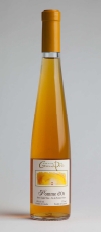
~ Pomme d’Or ~

Apple Dessert Wine

10% alc., 375ml, $22.50

The Facts

This apple dessert wine is made from both new and old apple varieties grown locally in the picturesque Annapolis Valley of Nova Scotia, a place world renowned for its apple production. A unique vinification process allows us to extract the pure sugar from the freshly pressed apple juice which is used for fermentation. The result is a spectacularly rich wine displaying complex notes of baked apple, apricot and caramel. A concentrated and sweet treat these wonderful flavors are balanced with a nice acidity and a long sweet finish.

Food Affinities

This dessert wine is a perfect compliment to any apple dessert, with mild cheesesand richly textured foods such as foie gras.

Awards

Bronze Medal Winner – 2003 All Canadian Wine Championship

Silver Medal Winner – 2004 NSLC Port of Wine Festival

Bronze Medal Winner – 2007 Canadian Wine Awards

Silver Medal Winner – 2008 Finger Lakes International Wine Competition

To purchase Pomme d’Or, you need to contact Grand Pre Winery directly. I checked with our local LCBO and sadly they no longer carry it. I say it’s a great excuse for a trip to the east coast!

I hope you “Like” Cooking With Sin on Facebook

Follow me, Carla Johnson, on Twitter @Carla_Johnson
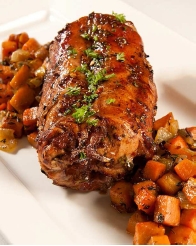
“Golden Apple” Roasted Rabbit

Posted on: August 9th, 2010 by Carla Johnson 1 Comment

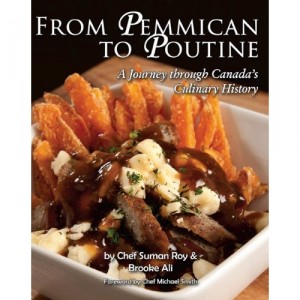
Recipe Courtesy : “From Pemmican To Poutine – A Journey through Canada’s Culinary History

All photos courtesy of Chef Suman Roy & Grand Pre Winery.

Author : Chef Suman 

With a lovely view of the Bay of Fundy, Grand Pre Estates Winery makes Nova Scotian wine in the beautiful Annapolis Valley. Their stately rows of grapevines grow unique grapes that have been designed to thrive in the particular growing climate of Annapolis Valley. Instead of growing Old World varieties like Chardonnay or Sauvignon, Grand Pre strongly believes that new wine producing regions should develop and perfect their own varieties, styles and vineyard practices to make wines that are born of and unique to their region. Not only does this create a truly Nova Scotian wine, but it makes it easier to grow the grapes without the costly and sometimes environmentally damaging methods needed to grown non-indigenous strains.

Grand Pre is the oldest winery in Nova Scotia. It was started in the 1970s by Roger Dial, who is considered the pioneer of Nova Scotia winemaking. He ran the winery until 1993 when it was purchased by Hanspeter Stutz. Stutz wanted to create not just wine but also a tourism experience, by renovating the grounds and offering vineyard tours in the summer and fall. They still make wines with their special grapes, but they now also offer unique varieties like icewine and their very special Pomme d’Or.

Pomme d’Or means “golden apple” in French and is a particularly apt name for this wine; the rich golden hue combines with the sweetness almost of an icewine to make it seem like you really are drinking sweet liquid gold. Made from six varieties of apples grown in the Annapolis Valley (Macintosh, Cortland, Russet, Northern Spry, and two secret varieties), the mix of old and new strains give the flavour and bouquet a complexity that makes it stand apart. The notes of baked apple, apricot and caramel pair beautifully with the saddle of rabbit and bring an unmistakable flavour to the marinade. Just make sure to save a few glasses for yourself.

Roasted Rabbit Marinated in Grand Pre’s Pomme D’Or

Serves: 6

Marinade:
1 cup Grand Pre’s Pomme D’Or
2 cups chicken stock
¼ tsp ground nutmeg
¼ tsp fresh tarragon, finely chopped
1 tsp garlic, finely chopped
1 tsp shallot, finely chopped
1 tbsp chili pepper flakes
1 tsp salt
1 tsp black pepper, freshly ground
 
Meat:
2 (2 lbs) rabbits
 
Roasting Vegetables:
3 sweet potatoes, 5 cm (2”) diced
2 carrots, peeled and 5 cm (2”) diced
1 celery stalk, 5 cm (2”) diced
1 onion, 5 cm (2”) diced
1 bay leaf

1. In a large mixing bowl mix together all of the ingredients for the marinade and marinate both rabbits overnight in a refrigerator.

2. Preheat the oven to 300°F.

3. In a roasting pan layer the bottom with the large diced vegetables, and place the 2 rabbits on top. Reserve any leftover marinade.

4. Roast in the oven covered for 3 hours until cooked through, basting occasionally with the leftover marinade. You will know it is cooked when the meat is almost falling off the bones.

5. Increase the oven temperature to 400°F and remove the cover to get an even golden brown colour on the rabbits.

6. Serve the rabbits with the vegetables and the juices from the pan.

Wellness Notes:

Rabbit meat contains niacin, selenium, phosphorous, iron, and B12. Look for grass fed rabbit, as grass fed animals contain more nutrition and healthier fats than grain fed animals of the same breed

Purchase a copy of Chef Suman’s new cookbook “From Pemmican to Poutine

UPDATE: Check out the Lobster Caesar recipe Chef Suman enjoyed for his birthday.

Carla Johnson Cooking With Sin

Carla Johnson Cooking With Sin

History of Alcohol – Part II

Posted on: June 27th, 2010 by Carla Johnson No Comments

Sumer (circa 2500 BC)

Region in ancient Mesopotamia, modern day Iran

Capital city was Uruk, probably largest in the world at the time

Brewing and drinking alcohol was a big part of the Sumerian life

Brewed a form of beer they called “kash”

• Made from a grain, converted into “happir” bread, fermented then grapes and honey added

• It was unfiltered, so you needed to drink it with a straw

Documented the brewing quality and amounts

Made 8 types from barley, 8 from wheat and 3 from mixed grains

Drinking was documented and regulated

A quote from the famous Sumerian poem, and possibly the oldest written work in existence, called Gilgamesh” (circa 2000 B.C.) translated into English

Enkidu knew nothing about eating bread for food,

And of drinking beer he had not been taught.

The harlot spoke to Enkidu saying,

‘Eat the food, Enkidu. It is the way one lives.

Drink the beer, as is the custom of the land.”

Enkidu ate the food until he was sated.

He drank the jugs – 7 jugs! He became expansive and sang with joy!”

http://elswet.50megs.com/paths/meso.html

Egypt (circa 3400 BC)

World’s oldest brewery found in the ruins of the city of Hierakonpolis

The common person drank beer & the rulers drank wine

Sumerian-style beer brewed

Could produce up to 3,000 gallons a day

Also the site of a significant pottery business

Main products were jugs and cups for beer

Very large number of relics remain

Beer was unquestionably a big part of the lifestyle

Many different varietals of wine

Wine was made and traded throughout the Middle East, mostly modern Israel & Palestine

http://www.touregypt.net/featurestories/hierakonpolis.htm

More on ancient Egyptian brews in the next installment…

I hope you “Like” Cooking With Sin on Facebook

Follow me, Carla Johnson, on Twitter

@Carla_Johnson


The History of Alcohol – Part I

Posted on: June 10th, 2010 by Carla Johnson No Comments

The first time ever I saw my grandmother drink alcohol was when she accepted a small glass of champagne on her hundredth birthday. She pronounced it to be pleasant but not so good as to want more.

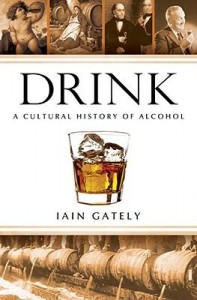
Drink-book-image

So begins “Drink: A Cultural History of Alcohol” by Iain Gately. I have been reading it in conjunction with creating this blog. He states this…

Alcohol is a fundamental part of Western culture. It is the most controversial part of our diet, simultaneously nourishing and intoxicating the human frame. Its equivocal influence of civilization can be equated to the polar characters of Dr. Jekyll and Mr. Hyde… In both ancient Greece, and the present millennium, it has been credited with the powers of inspiration and destruction.

I like Gately’s comment about his grandmother as it echoes my own grandmother’s story. http://cookingwithsin.com/2010/01/12/grandma-started-it/

Today, as in times past, alcohol is treated very differently depending on the time and place. In some places it has been primarily a food. In others it has been both a food and an intoxicant. In some communities it has been primarily an intoxicant and in others it is not welcome at all. There are a number of religions that use it as an important part of sacred traditions. Then there are religions that integrate it with caution, while other religions have banned in completely.

Generally, in North America it is integrated with caution, but that varies from community to community. We call the tax on alcohol a “sin tax.” (Not to be confused with “syntax.”wink)

According to Gately’s research, the first evidence of alcohol appears around 8000 BC. Humans had taken up agriculture and some communities had become sedentary. There are pottery jars in a grave in China that contain brew residues that date to 7000-6600 BC. These containers held a fermented drink made from rice, honey, grapes and hawthorn berries.

Other pottery fragments from the country of Georgia (beside Russia) date back to 6000 BC that used to contain wine and the containers were decorated with images of people raising their arms in celebration.

In what is now known as Iran, plants were cultivated for making alcohol as far back as 5400 BC. A jar was found with a yellow residue inside that proved it once held wine between 5400-5000 BC. It looks like it was intended both for nutrition and intoxication. It was the best way to retain grape juice over time.

By 3100 BC there is evidence that a beer was being brewed in the Zagros Mountains of Iran. It also may have been intended for both a stimulant and a food.

Fermenting was probably the only way to retain the nutritional quality of fruits and vegetables in times past. How much each society treated alcohol as a food or as a stimulant is hard to determine, but it definitely served both purposes.

This site contains a short, but interesting time line of the history of wine.

http://www.merryvale.com/wine-education/history-of-wine.html

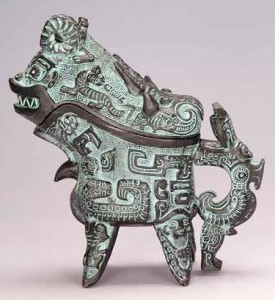
A Chinese wine server from approximately 1200 BC

A Chinese wine server from approximately 1200 BC

 "Carla Johnson" "Cooking With Sin"